
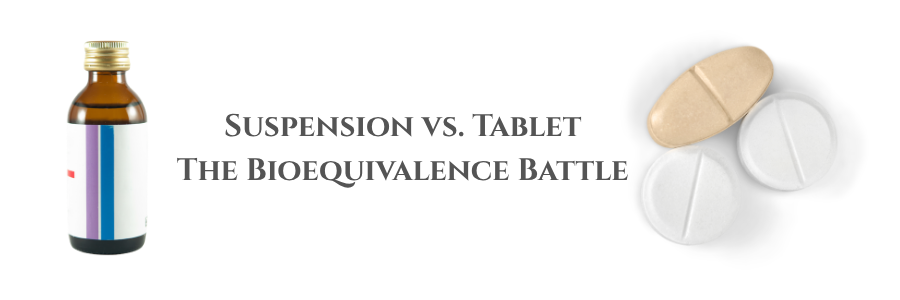
Ever wondered why the “same” drug can behave so differently in the body just because of its dosage form?
When transitioning a formulation from a solid oral dosage (Tablet) to a liquid oral dosage (Suspension), the stakes for Bioequivalence (BE) are incredibly high. It’s not just about the active ingredient; it’s about the delivery kinetics.
The Dissolution Dilemma
In a tablet, the rate-limiting step is often disintegration. The body has to break that “brick” down before the drug can even begin to dissolve.
With a suspension, the drug is already in a finely divided state, often bypassing the disintegration phase entirely. This can lead to:
- Faster Tmax: The time to reach peak plasma concentration is often shorter.
- Higher Cmax: Initial spikes in drug levels can occur if the suspension isn’t properly controlled. Proving Equivalence
To get the green light from regulators, we look at more than just a stir paddle in a beaker. We need to match the In-Vitro In-Vivo Correlation (IVIVC). While tablets focus on hardness and disintegration, suspensions rely on: - Particle Size Distribution (PSD): Smaller particles increase surface area, potentially skyrocketing dissolution rates.
- Rheology: Viscosity affects how the drug is released and swallowed.
- Sedimentation Rate: Ensuring the dose is uniform every single time the bottle is shaken.
The Takeaway
Developing a suspension isn’t just “liquifying” a tablet. It requires a deep dive into surfactant chemistry and physical stability to ensure that the AUC (Area Under the Curve) and Cmax align with the reference tablet.
Whether you’re working on a pediatric line extension or a geriatric-friendly alternative, the science remains the same: Precision in vitro leads to performance in vivo.
Read also: Role of Pilot BE Study Data in Designing a Pivotal BE Study
Resource Person: Janki Parmar